




Building the Infrastructure for Youth-Led Change: Scaling Open Mapping for Community-Led Environmental Action
A smartphone. An internet connection. ChatMap a free, open-source tool that turns WhatsApp messages into maps. And a network of young people determined to create a cleaner planet.
That's all it took for thousands of young people across Africa and the Caribbean to become environmental leaders, data creators and change makers in their communities.
Between June and September 2025, the World Cleanup Mapping Challenge, a collaboration between the Humanitarian OpenStreetMap Team (HOT), UNICEF, Generation Unlimited and YOMA proved that when you give young people accessible tools, quality training and trust in their capacity to lead, they can create real change.
The collaboration between UNICEF and HOT was initiated two years ago, and the success of the World Clean Up Day project highlights the strong strategic alignment of this partnership. Citizen science, large-scale youth mobilization, and open-source, crowdsourced mapping tools provided opportunities for mass participation and upskilling for everyone who took part.
The Challenge embodied the vision of Generation Unlimited, UNICEF’s global partnership connecting the world's 1.8 billion young people to opportunities for skilling, working, and social impact.
“This collaboration was born from Generation Unlimited’s long-standing commitment to empower young people through digital innovation and environmental action,” said Michael Scheibernreif, UNICEF Innovation Manager. “Partnering with the Humanitarian OpenStreetMap Team was a natural fit - they have deep experience in open mapping and in engaging youth networks, such as YouthMappers, across Africa and the Caribbean. Together, we wanted to bridge the gap between online learning and real-world impact. Our goal was to equip youth with the tools and confidence to take ownership of their communities - mapping local challenges, leading clean-ups, and showing that when young people are trusted to lead, they deliver meaningful, lasting change.
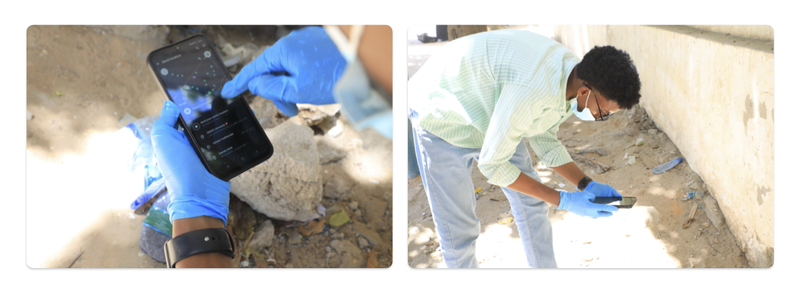
YouthMappers from the ICE Somali chapter using ChatMap to Map trash
The Sustainable Development Goals (SDGs) frame this initiative’s vision. While SDG 12 (Responsible Consumption and Production) directly addresses waste management and aims to reduce global waste by 2030 through prevention, recycling, and reuse, the challenge also contributes to SDG 11 (Sustainable Cities and Communities) and SDG 13 (Climate Action) by fostering cleaner, safer, and more resilient environments. Together, these efforts show how youth-driven environmental action, powered by open data and digital tools, can accelerate global progress toward a sustainable future.
The Problem Nobody was solving
Diana Laarie, a health administrator working in Ghana, saw it clearly: “We witnessed the impact of poor waste management in our surroundings and wanted to take practical steps to address it.”
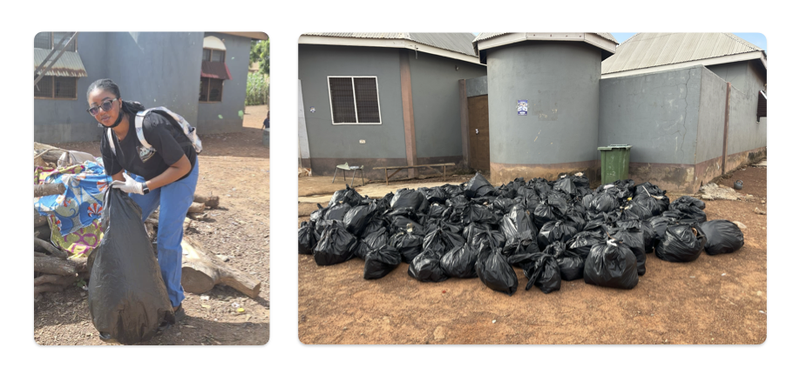
Bags of garbage collected in Tamale, Ghana
Across dozens of communities in Africa and the Caribbean, the pattern was identical: riverbeds polluted with plastic waste, markets with no proper disposal systems, and empty lots becoming unofficial dumpsites. Waste was visible everywhere. Yet data proving where it accumulated, how much existed and why it mattered to local planning did not exist.
In Mozambique, Iahaia Amade Mucussete Amisse witnessed the same challenges: “The Matola ‘A’ neighborhood, one of the most populous in Maputo, faces serious challenges related to climate change, especially flooding caused by poor drainage, waste accumulation and restricted mobility. To address this situation, we, the local youth, motivated by this common cause, joined the Challenge to clean up critical areas and improve the drainage system before the rainy season.”
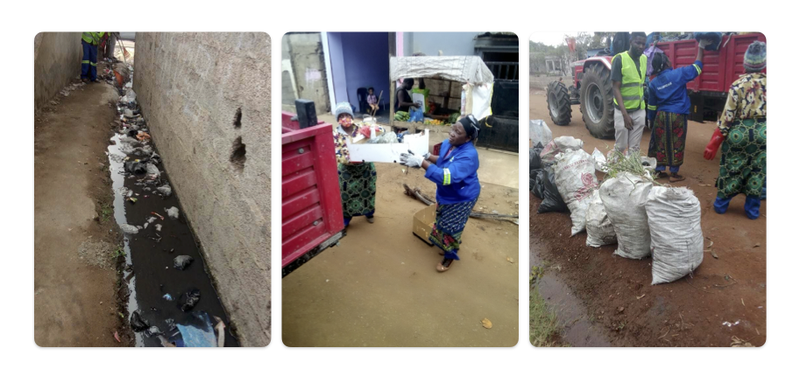
Youth cleaning up Matola in Mozambique with support from the community.
The resources we provided
The World Cleanup Mapping Challenge was designed around a simple but radical concept. Youth don't need supervision; they need resources and autonomy.
Here is what we provided
- Free accessible training and tools. Through HOT's Learning Center and the YOMA platform, young people learned how to map and use ChatMap, a tool that turns WhatsApp conversations into actionable maps by extracting location data from messages.
- Resource for planning. 92 youth leaders were selected to represent their community. Each received a stipend to plan and execute cleanup events in their communities.
“Our commitment is fundamentally to open-source and accessible technology. We intentionally developed the HOT Learning Center and ChatMap to remove common barriers to entry. Young people don't need expensive proprietary tools to lead change; they need simple, mobile-first resources that recognize them as capable data creators. By working in the open, we ensure the skills learned and the data created are free, reusable public goods that benefit the entire community.” Geoffrey Kateregga, the Humanitarian OpenStreetMap Team Community Projects Lead.

Youth cleaning up Haiti.
Yoma served as the digital foundation of the World Cleanup Mapping Challenge. Through the Yoma platform, youth accessed free HOT online courses, earned Verifiable Credentials (VCs) for their learning and contributions, and documented their community impact on Yoma. By integrating with HOT’s ChatMap and the Yoma Impact Exchange, Yoma made it possible to scale the process across countries and continents - turning WhatsApp-based mapping into verified data and youth-led environmental action. This seamless digital ecosystem allowed thousands of young people to learn, participate, and be recognized for their work, regardless of location or background.
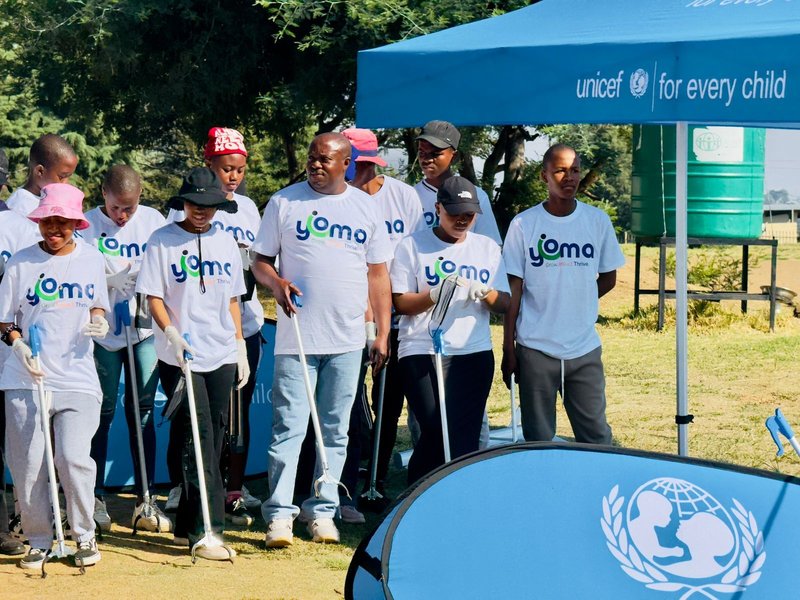
Assumption youth group from Lesotho during the World Cleanup Mapping Challenge day.
From Mapping to Action
Before the cleanup: Youth leaders mobilized 2700 youth who enrolled in a free course to learn mapping skills. Together they identified over 5,000 trash accumulation points.

Youth from Kenya, Nigeria, and Haiti during the World Cleanup Mapping Challenge.
Adamu Muhammad Adamu, a YouthMapper from Gombe State University in Nigeria, shared, “Our group joined because we believe in the YouthMappers' vision of moving ‘From Maps to Action.’ We wanted to show that the data we create through mapping can be turned into real community impact. Participating in World Cleanup Day gave us the opportunity to combine our mapping knowledge with physical action, raise awareness about waste management, and contribute to a cleaner and healthier Gombe metropolis.”
This included markets in Tamale, Ghana without disposal infrastructures; flood-prone riverbanks in Matola, Mozambique, informal settlements in Kibera, Kenya, where municipal services don't reach; and Bridgetown, Barbados facing coastal pollution
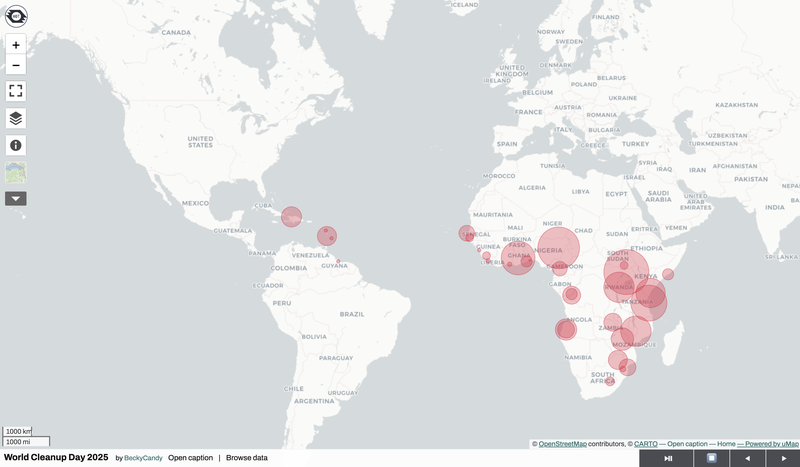
This heat-map shows trash points where pictures were taken for ChatMap
During World Clean up day 114,263 kilograms of waste were collected, which is the equivalent of 29 standard garbage trucks.
After the cleanup initiative, the waste was transported to designated landfills and recycling depots. In Sierra Leone, waste was sorted for recycling. In Ghana, nonrecyclable waste was safely disposed of in approved incineration facilities.
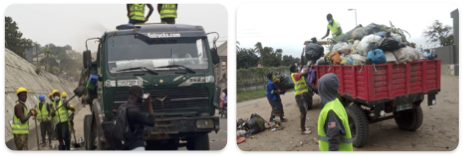
Youth loading up trash to be disposed of in designated landfills (left to right): DR Congo, and Mozambique.
In Dominica, the Caribbean Youth Environment Network Chapter (CYEN) highlighted that, "You don't always need a big group of people; sometimes it just takes a few individuals or even one person to start the ball rolling. Those who share your values will join you along the way.
Systems Responding to Youth Leadership
Across the regions local systems and communities responded to youth leadership.
- In Ghana, municipal officials joined the cleanup events.
- In Haiti, municipal representatives accompanied the youth along Limonade’s main street and took responsibility for transporting the collected waste to the designated site.
- In Kenya and Angola, residents stopped to thank mappers and asked how they could help.
- In Mozambique and Guyana, the city council offered tractors for waste collection.
- In Saint Lucia, the Youth Emergency Action Committees and the Caribbean Youth Environment Network led beach clean-ups, focusing on removing litter along the shoreline.
- In Tanzania, local leaders joined the youth in cleaning the community.
Youth Voices in Action
Scaling youth engagement is not just about increasing numbers, it is also about creating the right conditions for young people to lead. When they have access to free training, simple digital tools, and the freedom to make decisions, young people demonstrate the creativity and determination needed to solve local problems. Often, what limits them is not ability but opportunity. This challenge showed that once these barriers are removed, youth-led action can motivate peers, influence local systems, and create lasting impact in their communities.
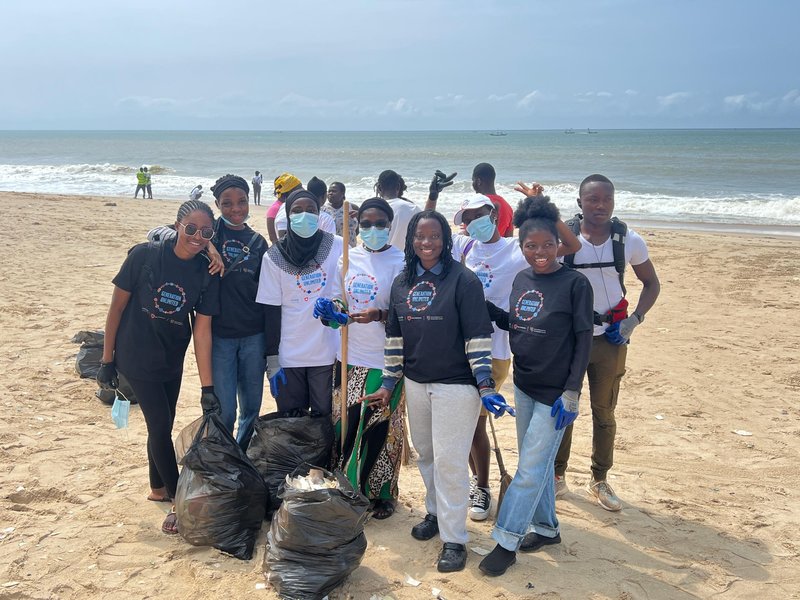
Youths from Ghana during the World Cleanup Mapping Challenge
To capture the spirit of youth leadership across 91 groups, we analyzed the words most frequently used in participants’ reflections. The word cloud below illustrates the powerful themes that emerged - from teamwork and cleanliness to community, change, and action. It proves that environmental action is not just about cleaning spaces but also about building communities.
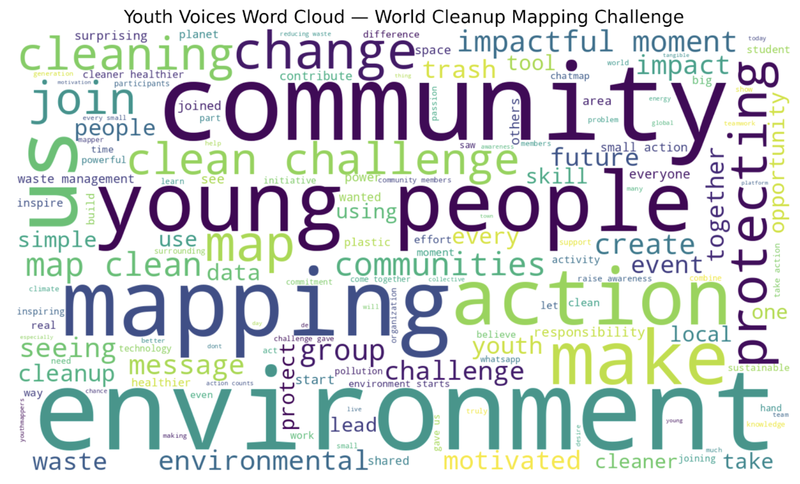
Word Cloud showing top keywords from youth reflections on the World Cleanup Mapping Challenge. Common themes include teamwork, community, waste, change, and environment.
What we Learned
The World Cleanup Mapping Challenge demonstrated that youth-generated data can be more than just information - it can serve as valuable evidence to inform local decision-making. Young participants collected actionable insights for their communities, proving that data collection can be simple, inclusive, and impactful. Looking ahead, UNICEF aims to expand this model for community data to support planning and policy processes, ensuring that the evidence youth creates continues to shape sustainable and resilient futures.
The World Cleanup Mapping Challenge taught us this: give young people the tools, trust them with decisions, and watch them lead.
Young people have the capacity to solve community problems. What they often lack is access to tools, training resources and institutional trust. By removing systematic barriers such as access to information, developing tools that are community centered, supporting independence and giving youth complete autonomy, young people can lead.
About the Authors
Authors: Pauline Omagwa (Humanitarian OpenStreetMap Team) and Chen, Qiqi (UNICEF)
Contributors: Geoffrey Kateregga, Karen Asaba, Leah Khanya, Mar Marin, and Michael Scheibernreif
Acknowledgments: This story was made possible by the 2,682 young people who participated in the World Cleanup Mapping Challenge and generously shared their experiences.
About The Humanitarian OpenStreetMap Team (HOT) is an international nonprofit dedicated to participatory mapping as a means to accelerate sustainable development and humanitarian response. Through open-source tools, community networks, and commitment to local leadership, HOT supports millions of people worldwide to create the maps that matter most to them.
YOMA is a global solution of UNICEF’s Generation Unlimited (GenU), a global Public-Private-Youth partnership connecting young people to opportunities in employment, entrepreneurship, and social impact. Yoma has been at the forefront of youth empowerment for the past five years.